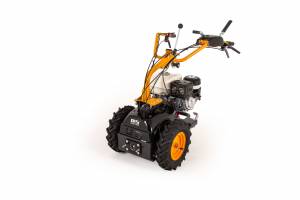
Belt rake 120 cm


Einsätze
-
 Mulching is a process by which grass cuttings are shredded several times into a fine mulch, which then remains on the surface as natural fertiliser. Special mulching blades with a double cutting plane and a circular mulching unit are used on ornamental lawns, while cross-blade systems or flail mowers are primarily used in high grass.
 -
Ornamental lawns in both private gardens and public facilities can be maintained with either mulching or collecting mowers. When mulching, the finely-shredded cuttings remain on the surface as natural fertiliser, while collection bags help the operator transport cuttings to a disposal point. Lawns are usually mowed once per week to a cutting height of 40–50 mm, from a maximum height of 15 cm.
-
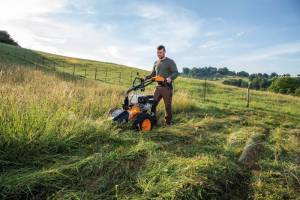
Flower meadows are structurally rich habitats that are extremely important for insects, wild bees, and species that depend on flowers. The key is not to mow frequently, but to cut at the right time. Before the flowering phase, the vegetation can quickly reach heights of 30–40 cm. After that, maintenance is carried out at longer intervals, usually once or twice a year. This form of extensive use requires machines that can safely cut tall, heterogeneous vegetation without putting unnecessary strain on the area. Clean cuts, controlled deposition, and an adapted driving style are essential for preserving plant populations and enabling regeneration.
-
Extensively used meadows such as orchards, compensation areas, or roadside greenery are deliberately mowed only once or twice a year. The vegetation reaches heights of 60 to over 100 cm and forms dense, structurally rich stands. This form of maintenance serves to keep the area open and suppress woody plants, not to maintain the lawn. Machines with high throughput, uniform cutting performance, and controlled deposition of the cut material are required. This is the only way to efficiently manage large amounts of biomass without overloading the area or damaging the soil and vegetation.
-
Without maintenance, open areas quickly become overgrown with blackberries, clematis, and young trees. In young forests, reforestation areas, or Christmas tree plantations, targeted brush clearing is necessary to secure the desired structures and reduce competition. It is crucial to use maintenance methods that intervene selectively and do not destroy large areas. Mechanical flail mowing technology makes it possible to remove woody growth and vigorous shrubs without unnecessarily damaging the soil structure and root space. This ensures that areas remain usable and ecologically stable in the long term.
-
During the mowing season, professional operators often run their machines 5 days per week, 8 hours per day. AS-Motor’s machines are unbeatable in terms of quality, durability and professional work results. Additional advantages include low weight, lashing points and compact transport dimensions.
-
Animal burrows, anthills, mole hills and water channels cause uneven terrain. Several AS-Motor machines have high ground clearance, all-wheel drive and limited slip differential, along with appropriately studded field tyres, for uneven terrain.
-
AS-Motor engineers machines with high ground clearance, steep ramp angles, low overall weight, optimal weight distribution and a low centre of gravity to perform on slopes.
-
All-wheel drive not only ensures performance on inclines over 30 degrees, but also a high level of safety for travel downhill. All-wheel drive delivers propulsion in wet conditions and on uneven terrain – even if the wheels of one axle no longer have traction.
-
Remote controlled devices make the mowing of extreme slopes possible. This technology also allows the operator to mow at a safe distance from dust, wasps, ticks and other hazards.
-
 The AS 50’s high work rate delivers efficient weed removal on large and uneven surfaces such as a car parks, commercial areas and paths. A collection bag eliminates the need for sweeping and surface cleaning.
 -
 Cobblestones and uneven paved areas can be treated for weeds, without the use of chemicals, using mechanical methods. The agile AS 30 is designed for work close to edges, water inlet channels, manholes and on traffic islands with posts and signs.
 -
-
-
-
-
-
-
-
-
-
-
-
Ecological mowing and extensive land management focus on reduced, targeted interventions instead of blanket mowing. Cutting heights, timing, and maintenance intervals are based on vegetation development and site conditions, not on maximum area coverage. Sub-areas are mowed on a rotating basis, while others are deliberately left untouched. This creates varying growth heights, refuges, and stable structures on extensive meadows, compensation areas, municipal green spaces, and in landscape management. Technology is used for control, not intensification.
-
-


Removing cuttings made easy
Often, grassland maintenance is not finished with mowing. The next step is to remove the cuttings from the area to prevent nutrient enrichment. The scarcity of nutrients on certain grassland sites is an important prerequisite for the flowering of numerous herbs (such as meadow sage). Thus, nutrient-poor sites produce a more colorful and diverse plant composition. In addition, these sites are often more maintenance-extensive, meaning they require less mowing.
Swathing or turning
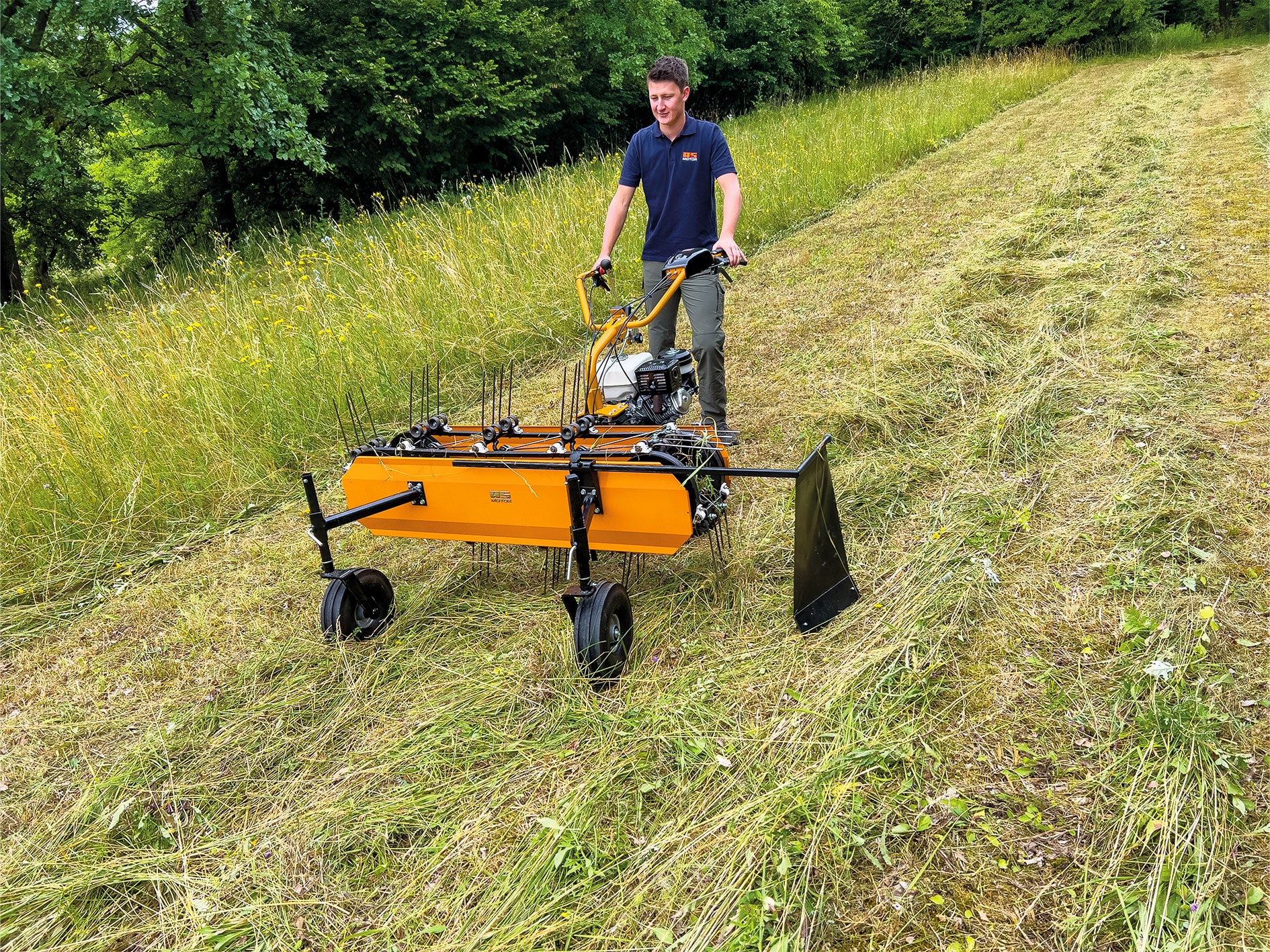
The belt rake can also be used for forage production in various functions for small-scale farming. In the first step, the machine acts as a tedder with higher engine speed and without swath cloth. With swath cloth and lower speed, the forage is then conveniently raked together.
Quick change of attachments
With just two bolts, the attachments are fastened to the implement carrier’s coupling. Changing to another attachment, such as a sweeping brush or flail mower, takes only a few minutes. The support foot of the equipment carrier facilitates mounting.
Product advantages
Thanks to the two sturdy drive belts, the mounted belt screen runs with low vibration and noise. Working with the device is therefore pleasant for the operator and the environment.
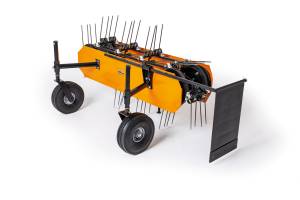
Robust tines (10 rakes in total) and belt drive.
Due to its compact dimensions, the belt rake is ideally suited as an attachment for the AS 600. With a working width of 120cm, a high area performance (approx. 6.000m²/h) is possible.
Produktdetails

Coupling and support foot
Drive of the belt rake via the three-claw coupling of the AS 600 MultiPro. Comfortable parking of the machine via the height-adjustable support foot.

Double v-belt drive
Robust drive via two V-belts. Controlled tines ensure clean pick-up of the crop.

Adjustable swath cloth
Variable adjustable swath cloth to match the amount of forage. With the swath cloth removed, the belt rake can easily be used for turning at a higher speed.

Height adjustment
Variable adjustment of the working depth on the two front support wheels. Freely rotating front wheels ensure maximum maneuverability of the machine.