Prepare for winter storage - Ready for the coming season - Part 1
The ideal time for a comprehensive equipment check of lawn mowers, ride-on mowers and other motorised garden aids is when preparing the machines for winter. Few know better what to look out for during this process than Wolfgang Gerlach. The trained mechanic has worked for 35 years at the high grass mower manufacturer AS-Motor in Bühlertann.
In a small series, we have summarised the motor expert’s comprehensive knowledge of winter checks. In the first part, we first deal with basic things that must be observed and then go into detail regarding the body, the frame and the cutting head.
Benefits of the winter check
A comprehensive equipment check before the machines are stored for the winter kills three birds with one stone. First, the machines are thoroughly cleaned and preserved; second, faults are detected by checking the functions. Third, it shows where there is a need for action or repairs by a specialist. The main purpose is to ensure that the motorised helpers are functional and ready for use the following spring. The working environment and safety are also an important factor here. Blades and flails are constantly subjected to high stress and wear. At blade speeds of sometimes more than 200 km/h, everything must be in top condition. The equipment check contributes to a machine’s extended service life and increased value retention.

Our motor expert: For 35 years, Wolfgang Gerlach has worked at AS-Motor as a test mechanic in prototype construction and the motor test bench.
Before we start
Every check begins with necessary safety measures. For example, the possibility of an accidental start of the machine must be eliminated before any action can be taken. For this reason, the main contacts must be disconnected on electric lawn mowers. For battery-powered machines, remove the batteries and, if necessary, activate the shut-off button or remove the safety key. On motorised machines with a pull start, you must remove the spark plug connector. To be on the safe side with ride-on mowers, remove the ignition key and, if possible, disconnect the battery before you start working on the machine. Close fuel taps and tank ventilation. Basically, good ventilation must be ensured and the machine must be standing securely. Make sure there are no ignition sources nearby and wear cut-resistant gloves.
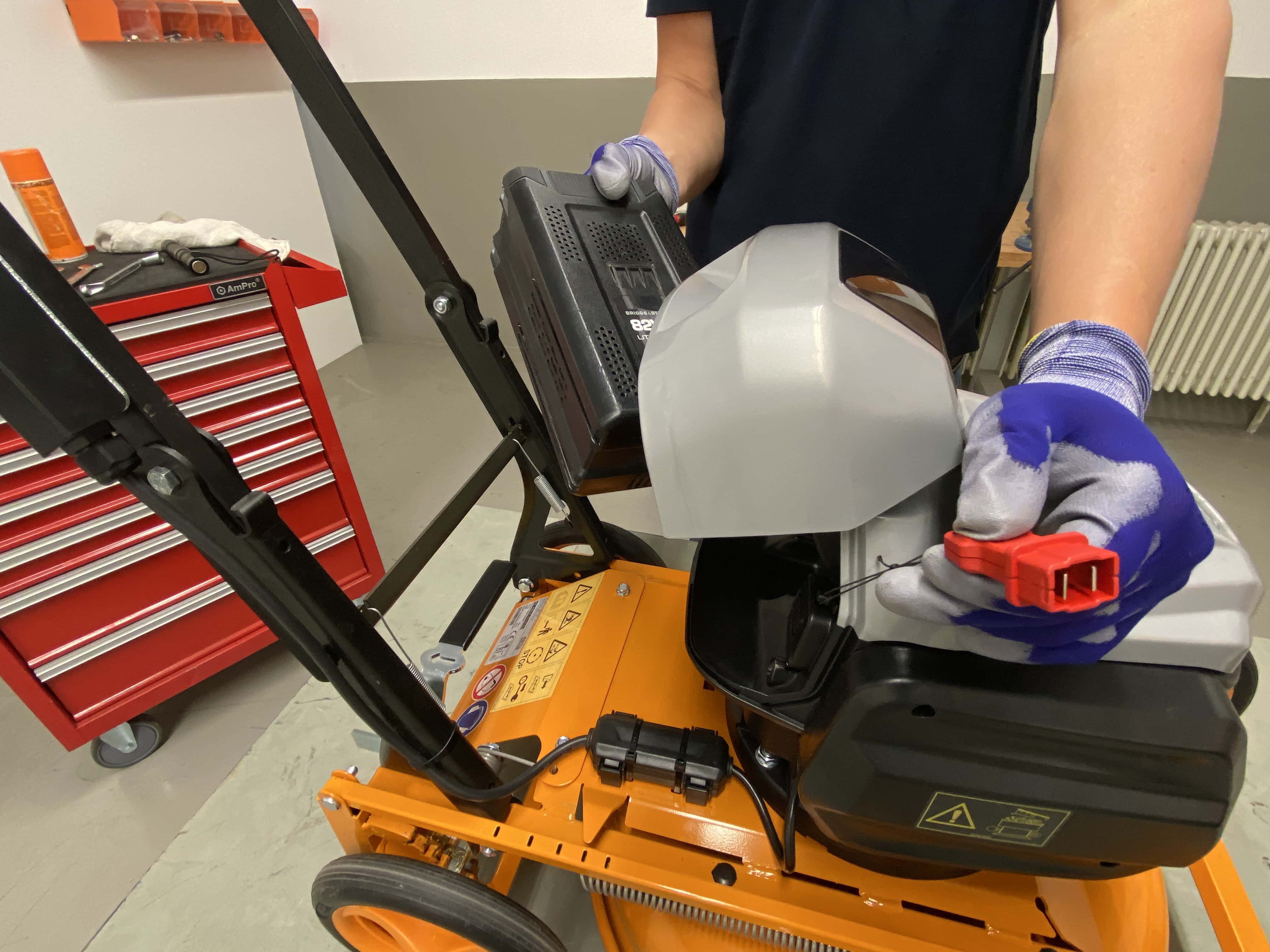
Some safety measures
Fresh shine and well lubricated
To clean the body and frame, first brush off loose dirt, dust, leaves and branches with a hand brush. Stubborn dirt can be removed with a damp cloth and mild cleaning agent. The expert from AS-Motor points out that decomposed, damp grass and leaves are particularly corrosive to metals and surfaces. Therefore, pay attention to rotting nests in corners and angles on your machine. The body can be cleaned particularly gently and effectively with compressed air. We do not recommend the use of high-pressure cleaners, which degrease sensitive bearings and components. Cleaning agents are often particularly corrosive. Spring water from the hose can be used instead. However, avoid sensitive and electrical parts and do not direct water jets at bearings.
Bowden cables and their outer sheaths can be checked while the body is being cleaned. Rub marks, kinks, dents and broken strands prevent proper functioning. Further damage can also occur if, for example, a clutch does not disengage from the gearbox properly. For this reason, test the movement of the cables and the final fasteners. It is best to use a silicone-based lubricant to lubricate the Bowden cables. Unlike oils and greases, silicone does not harden, and less dirt sticks to it.
After cleaning, all joints, hinges and control levers can now be lubricated with a resin-free multifunctional oil. Pay attention to ensure that no lubricant, oil or wax gets on drive or V-belts, pulleys, brake linings or dry clutches.
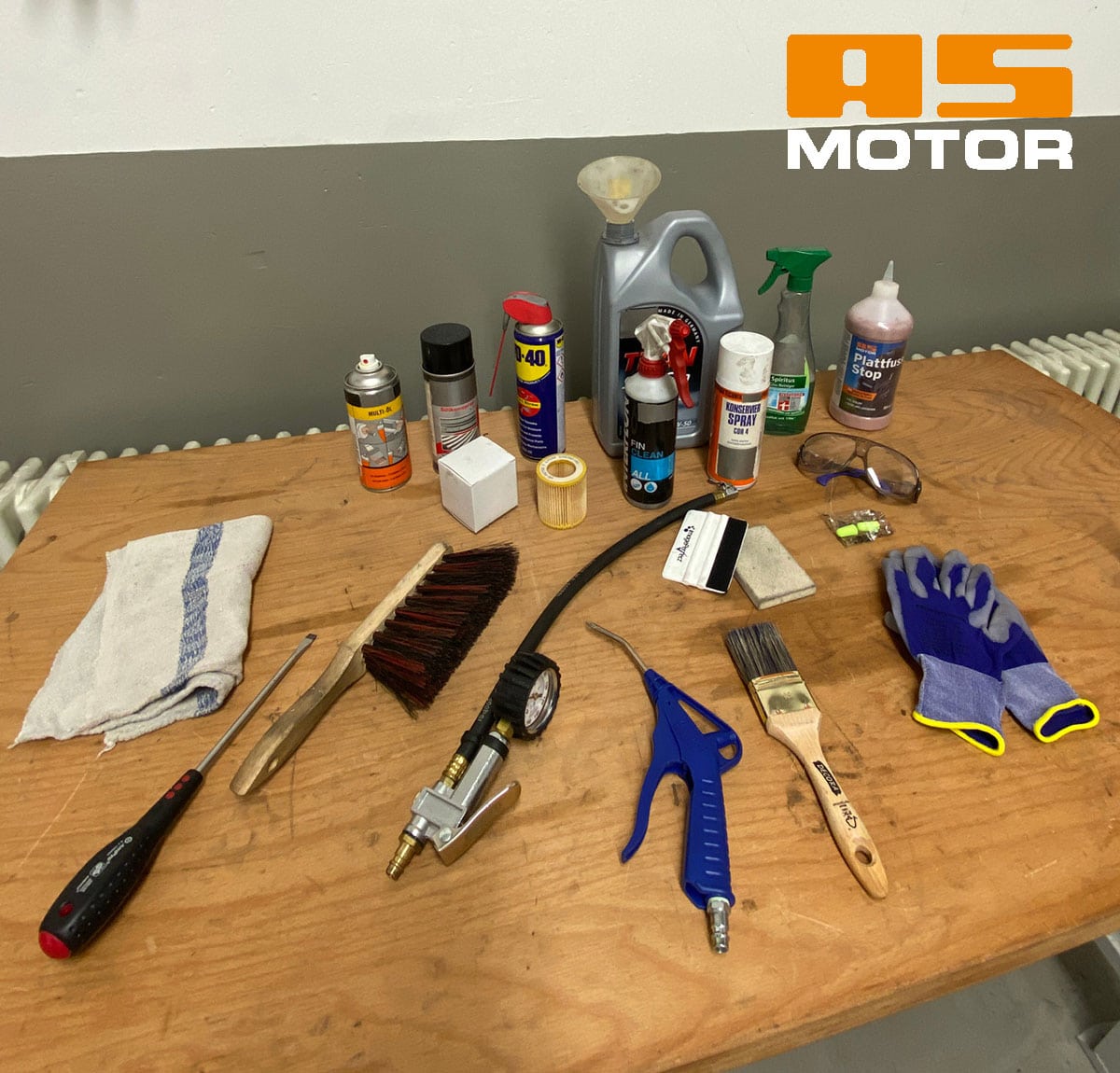
Everything you need for the winter check
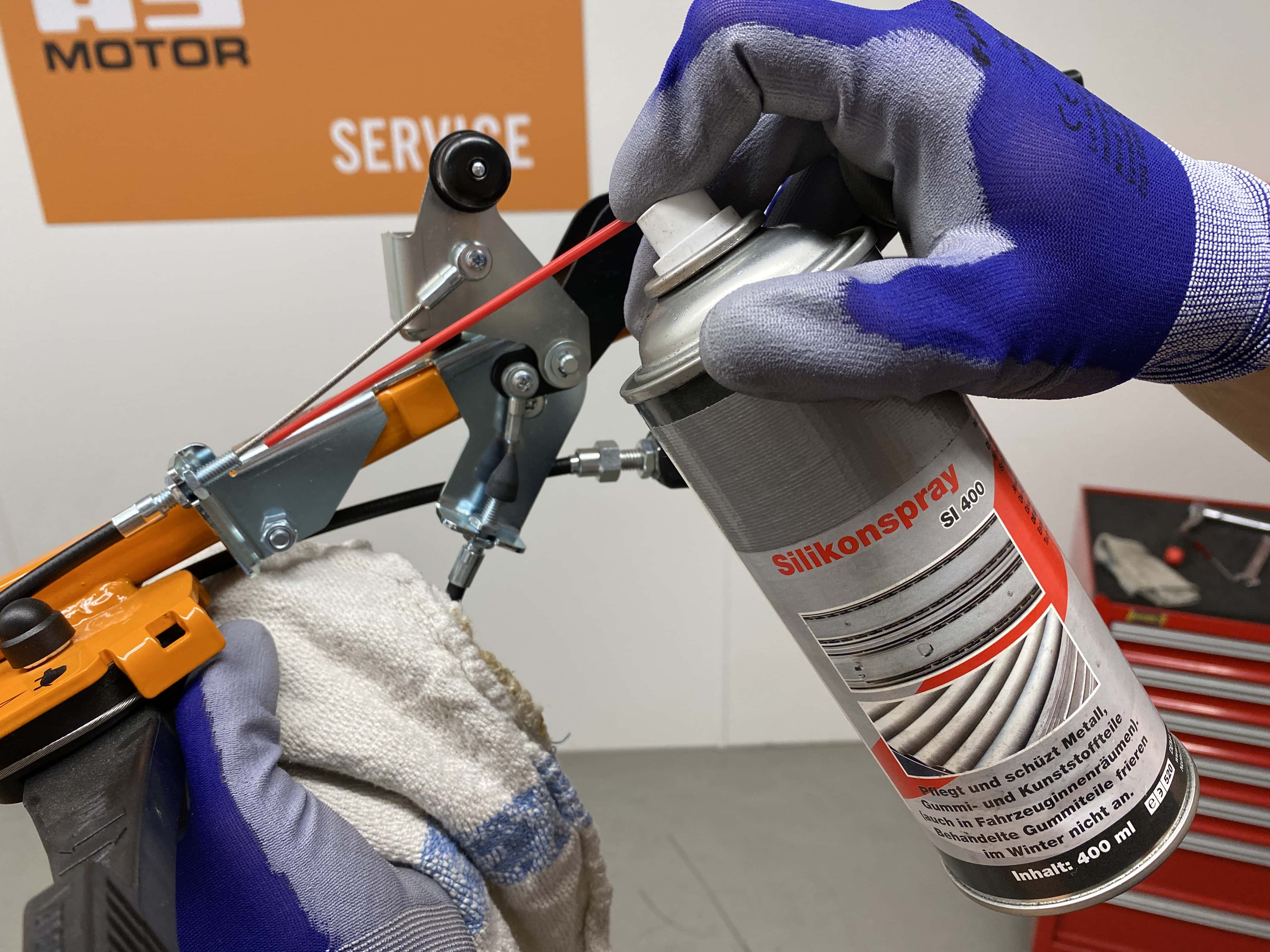
Silicone spray is used for Bowden cables because it does not stick or harden
Clean the lawn mower
For proper cleaning, lawn mowers must be stood up, folded over or tilted to the side. This is no problem with electric or battery-powered lawn mowers, which can be placed on any side as they have no oil in the engine. For combustion engines, proceed as follows: Close the fuel tap and the fuel tank vent. If the tank cap is leaking, empty the fuel in advance. After removing the air filter, the lawn mower can be placed on its side. Pay attention to the fact that with 4-stroke engines, the air filter housing must always be at the top when the lawn mower is folded down, i.e. above the crankcase. Otherwise, engine oil will run into the air filter housing and contaminate the intake duct and air filter.
Service stands can be used to safely tilt a ride-on mower. These are available from specialists. Otherwise, the machine can be driven onto ramps to make it accessible from underneath. Secure the ride-on mower so that it does not roll away or fall over.
Now you can start cleaning the cutting head. Pay attention to the sharp cutting tools. There is a risk of injury here. It is best to clean lawn mowers and cutting heads immediately after the last use, as the grass residues sticking to them will still be moist. Use tools made of wood or plastic to scrape so that you do not unnecessarily damage coated surfaces.
Although the use of a high-pressure cleaner is not recommended, it can significantly facilitate the work when cleaning the cutting head. In this case, however, it is absolutely necessary to follow the following instructions: Use it only to clean the metal or aluminium surfaces on the underside of the cutting housing, and do not use any cleaning agents. Avoid the blade bearings, crankshaft and blade coupling when working with the pressure washer and maintain a nozzle distance of 20-30 cm. After wet cleaning, it is advantageous to run the machine for a short time. Water residues will fly off the moving parts or be displaced by the air flow.
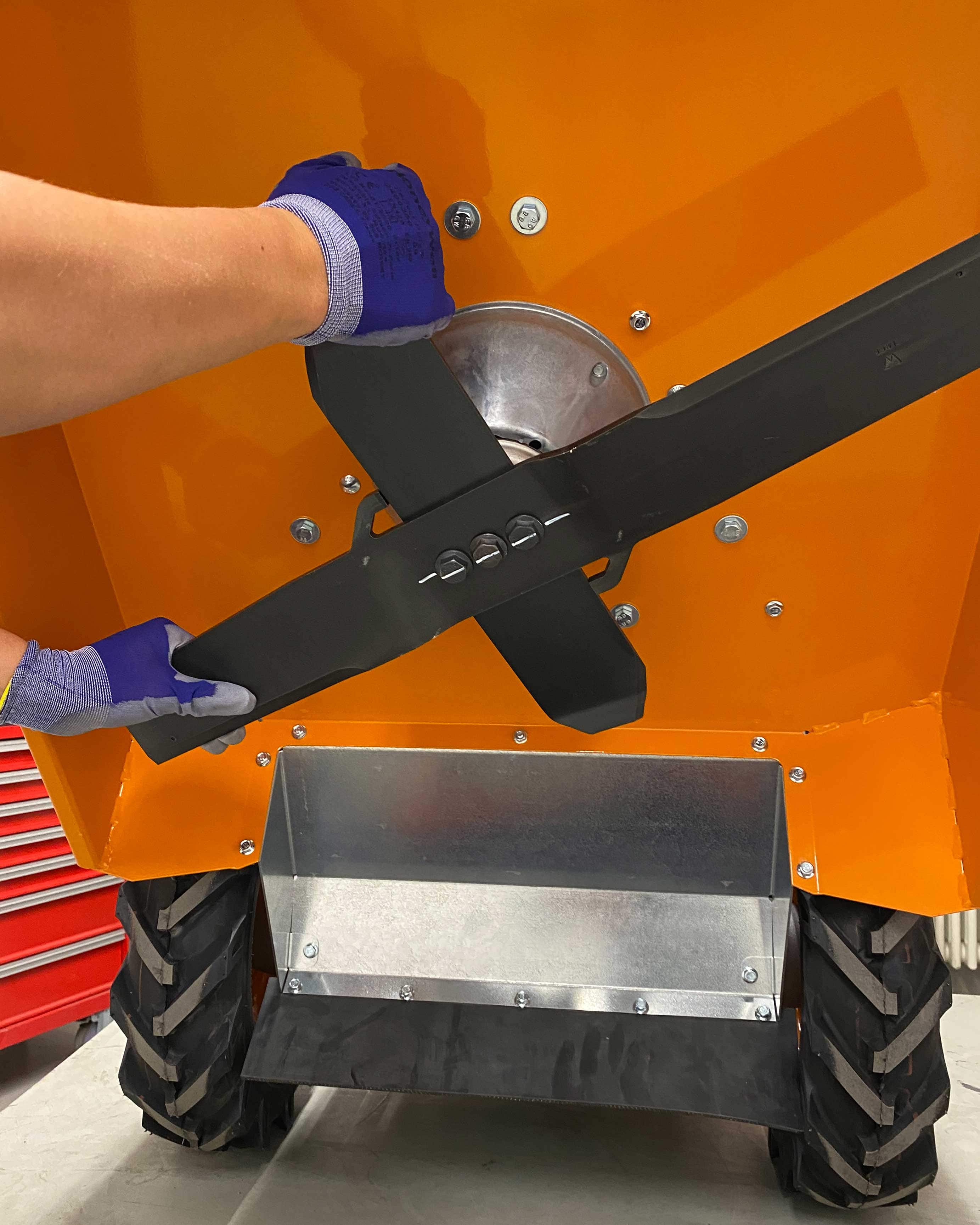
To clean the lawn mower, it must be turned upside down or tilted to the side. Special precautions are required for devices with combustion engines.
Are the blades still okay?
After cleaning, inspect the blades. Some questions must be answered: Are there any cracks, deformations or damage? Are the blades sharp or do they need sharpening? Has the wear on the blades already reached the minimum mark? Are the locking screws loose or worn? Are all guards or ejection guards intact?
If you discover any irregularities during the inspection of the blade system and its protective covers, a specialist workshop must carry out any necessary repairs. Faulty blade systems pose a great danger to users and passers-by. Blade repairs may therefore only be carried out by a specialist. Even when simply sharpening blades and knives, it is necessary to check for imbalances afterwards. Without special tools, vibrations will permanently damage the machine.
Well protected through the cold season
After cleaning and blade inspection, the cutting head and blades are preserved from the underside and protected against winter corrosion. Use wax- or oil-based care products for this. The AS-Motor expert points out that no surface coating, whether paint, powder coating or galvanising, will last permanently in a cutting head. These surface coatings are no match for swirling stones and sand, aggressive plant juices and permanent moisture. Light rust and corrosion are therefore normal. During regular operation, this plays an insignificant role in durability. Only long-term storage in a dirty condition will allow sheet steel to rust through. For this reason, the big annual cleaning should be carried out before the machine is left for the winter.


