CO₂ values according to EU Stage V
EU Stage V emission regulations – what you need to know
New environmental standards for non-road mobile machinery
The introduction of EU Regulation 2016/1628 and its amendment 2020/1040 has significantly changed the industry by introducing stricter Stage V emission standards for non-road mobile machinery (NRMM). These regulations aim to reduce air pollution by setting new limits for particulates (PM), nitrogen oxides (NOx), hydrocarbons (HC), and carbon monoxide (CO) for combustion engines.
At AS-Motor, we are committed to delivering high-performance mowing solutions that meet the latest environmental and regulatory requirements. From 1 January 2022, all newly introduced machines must be Stage V compliant, ensuring reduced emissions and improved sustainability for professional and municipal users.
Understanding the Stage V compliance timeline
The transition to Stage V engines has been a phased process affecting different engines at different stages:
- From 1 January 2019: New engine type approvals required Stage V compliance.
- From 2020 onwards: Many engines could no longer be sold if they did not meet Stage V standards.
- Until 31 December 2021: Machines with pre-Stage V engines could still be placed on the market.
- From 1 January 2022: Only Stage V compliant engines may be installed in new machine equipment sold within the EU.
This transition period allowed manufacturers, dealers, and end customers to phase out non-compliant stock while adopting cleaner, more advanced engine technologies.
CO₂ emission values – transparency for customers
CO₂ values were not determined in the previously valid exhaust measurements and therefore cannot be specified. You can find out the CO₂ values for Stage V engines via the engine type approval number and the lists from the respective engine manufacturers linked here. You can find the type approval number on the engine on the unit.
To find the CO₂ values for a specific Stage V engine:
- Find the type approval number on the engine label.
- Refer to the manufacturer's published Stage V CO₂ emission list.
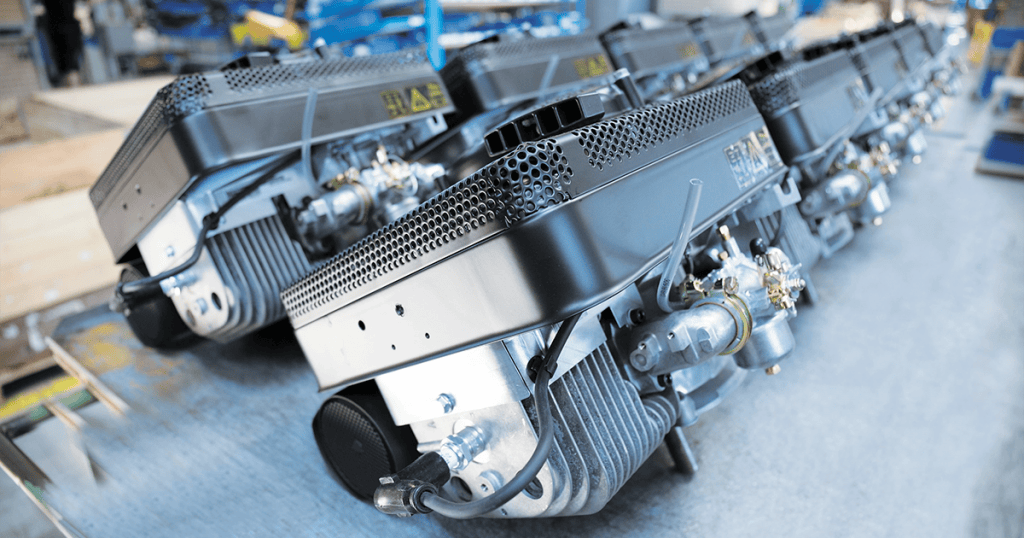
For example, the AS-Motor 2-stroke engine (165cc) is one of the few two-stroke engines certified according to Stage V, demonstrating innovative technology that meets modern emission standards. AS-Motor also provides access to Briggs & Stratton, Honda, and Kawasaki engine CO₂ data via their official documentation.
Briggs & Stratton engines | Honda engines | Kawasaki engines
AS-Motor Stage V engine CO₂ values
AS-Motor 2-stroke engine
- Family name on the emission label: AS 165 GC
- Type approval number: e12016/16282016/1628SHB3/P012901
- CO₂ value (g/kW-h): 1110.45
XP140 Engine (AS 30 WeedHex 140)
- Family name on the emission label: 5X65MU
- Type approval number: e92016/16282017/656SYA1/P102400
- CO₂ value (g/kWh): 854.37
XP200 Engine (AS 585 KM)
- Family name on the emission label: XP225A
- Type approval number: e92016/16282017/656SYA1/P102100
- CO₂ value (g/kWh): 828.09
Stage V regulations also require manufacturers to publish CO₂ emission values for each certified engine. These values are measured under laboratory conditions with standardised test cycles, ensuring transparency for buyers. However, actual emissions may vary depending on operating conditions, maintenance, and load factors.
Continued use of older engines
While all new machines must comply with Stage V regulations, engines that were placed on the market before 31 December 2021 may continue to be sold and used indefinitely. This rule allows companies to continue using existing equipment while transitioning to newer, lower-emission technologies. However, all new machines introduced to the EU market must meet Stage V standards.
AS-Motor's commitment to sustainability and compliance
At AS-Motor, we understand the importance of meeting environmental regulations while continuing to deliver the high mowing performance that professionals rely on. Our equipment is designed to meet Stage V standards, ensuring reduced emissions without compromising on power, efficiency, or reliability.